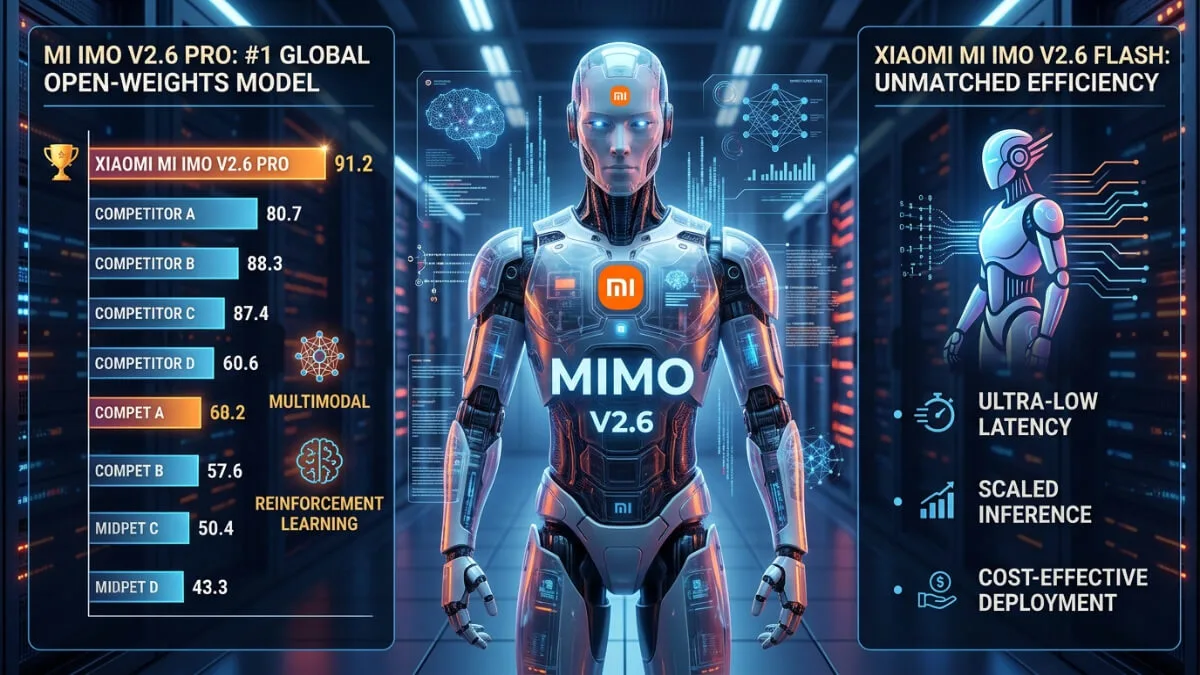
Xiaomi released and open-sourced its flagship MiMo-V2.6 artificial intelligence model series on September 22, 2026, introducing the MiMo-V2.6-Pro and MiMo-V2.6-Flash checkpoints. The company scaled multi-task reinforcement learning compute across coding, visual, cybersecurity, and general agent environments to advance recursive self-improvement, publishing model weights, code, and technical reports on Hugging Face.
Key Takeaways
- Top Open-Source Benchmarks: MiMo-V2.6-Pro achieved a score of 46.32 on the Artificial Analysis Intelligence Index, outperforming leading open-weight competitors like Kimi K3 and Qwen3.8 Max.
- Omnimodal Native Architecture: Native processing for text, image, video, and audio inputs paired with a 1M token context window for complex repository-level agent tasks.
- Scaled Reinforcement Learning: Trained using asynchronous Group Relative Policy Optimization (GRPO) across 750,000 trajectories to establish self-improving reward loops.
- Public Availability: Weights for both MiMo-V2.6-Pro-RL and MiMo-V2.6-Flash-RL are immediately accessible on Hugging Face and ModelScope under open licenses.
Breakthrough Architecture: Scaling RL for Recursive Self-Improvement
The MiMo-V2.6 release centers on scaling reinforcement learning (RL) compute during post-training rather than relying solely on pre-training expansion. Xiaomi allocated millions of dollars in compute over a six-day training run to evaluate trajectory-level feedback across complex multi-step tasks.
The engineering team implemented Groupwise Agentic Grading (GAG) to overcome the limitations of binary pass/fail verification. By synthesizing dynamic task rubrics through contrasting rollouts, the model learns to evaluate its own intermediate reasoning steps.
Raw Multimodal Input (Text/Image/Video/Audio)
                    │
                    ▼
       Native Omnimodal Tokenizer
                    │
                    ▼
  1M Context Window Processing Engine
                    │
                    ▼
Groupwise Agentic Grading (Self-Correction Loop)
                    │
                    ▼
     Optimized Agent Action & Code Output
This training pipeline allowed MiMo-V2.6-Pro to make substantial jumps in software engineering benchmarks like DeepSWE v1.1, climbing from a 19.0 score in MiMo-V2.5-Pro to 71.9.
Pro vs. Flash: Performance and Technical Specifications
Xiaomi structured the release around two core variants tailored for different operational deployment constraints, alongside an UltraSpeed inference tier.
| Feature / Metric | MiMo-V2.6-Pro | MiMo-V2.6-Flash |
| Primary Focus | Maximum Reasoning & Agent Capability | High Efficiency & Speed |
| Context Window | 1,000,000 Tokens | 1,000,000 Tokens |
| AA Intelligence Index | 46.32 | Competes with tier-1 mid-size models |
| DeepSWE v1.1 Score | 71.9 | 67.9 |
| Training RL Compute | ~$2.62 Million USD | ~$850,000 USD |
| Primary Use Case | Complex code, 3D world builds, security analysis | Real-time agents, high-throughput pipelines |
Advanced Capabilities in Vibe World and Cyber Security
Beyond standard text and code processing, MiMo-V2.6 expands into interactive task creation termed Vibe World. The model coordinates multi-agent workflows to translate prompt inputs into fully interactive 3D game scenes, interactive logic scripts, and Blender assets.
In cybersecurity, MiMo-V2.6-Flash achieved 95.1% on the CyberGym benchmark. The training strategy mixes general agents, coding, visual tasks, and vulnerability testing into unified batches, enabling cross-domain strategy transfer across unseen verification environments.
How to Access and Deploy MiMo-V2.6
- Download Weights: Access
XiaomiMiMo/MiMo-V2.6-Pro-RLorXiaomiMiMo/MiMo-V2.6-Flash-RLrepositories on Hugging Face. - API Access: Integrate via OpenRouter or Xiaomi’s official API endpoints using standard OpenAI-compatible SDK call structures.
- Local Deployment: Run inference pipelines using frameworks supporting asynchronous batch processing to take advantage of the 1M token context window.
Frequently Asked Questions
What makes Xiaomi MiMo-V2.6 different from previous versions?
MiMo-V2.6 uses massive multi-task reinforcement learning post-training instead of standard fine-tuning, dramatically increasing performance across coding, cyber security, and autonomous agent benchmarks.
Are the Xiaomi MiMo-V2.6 models completely open source?
Yes, Xiaomi has publicly released the model weights, technical documentation, training environments, and RL code on platforms like Hugging Face and ModelScope.
What hardware is required to run MiMo-V2.6 locally?
MiMo-V2.6-Flash can run on mid-range enterprise GPU setups for efficient throughput, while the flagship MiMo-V2.6-Pro requires high-memory cluster infrastructure to handle its full 1M token context capacity.

Faraz Shah Skills ✔ Verified
Faraz Shah Skills is a technology educator and content writer. He shares authentic, detailed insights on news, guides, and trends to help readers make informed decisions with clear and trustworthy information.