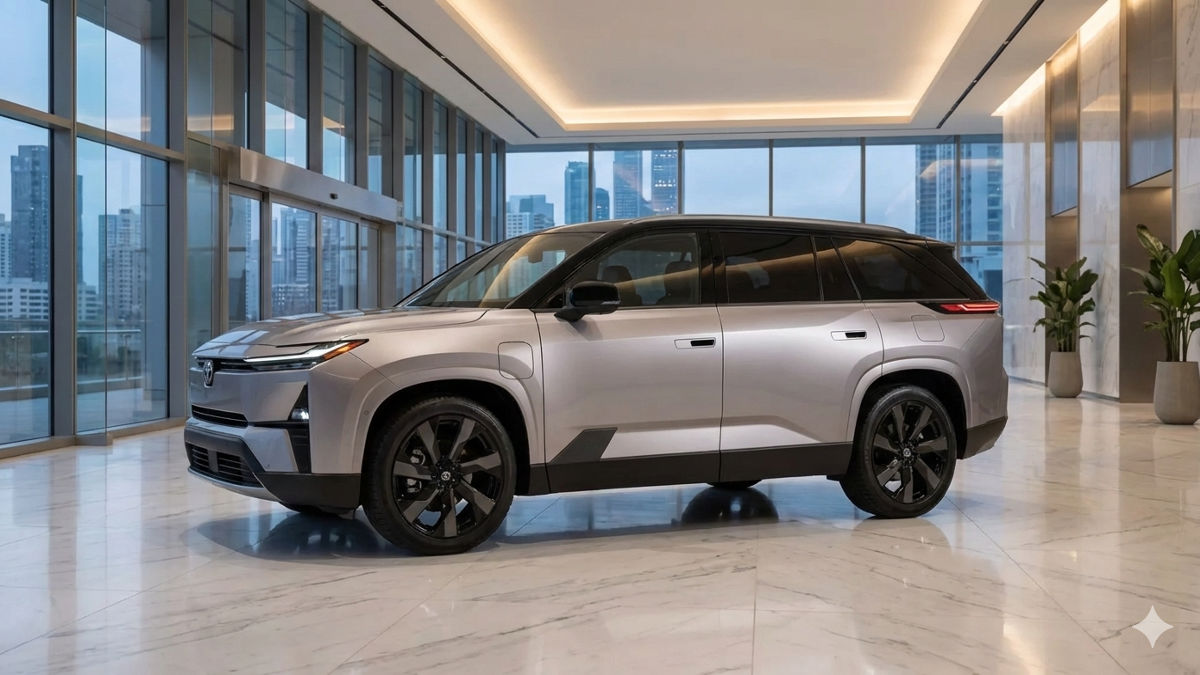
Roughly eight months ago, Toyota invited a small group of journalists to its U.S. headquarters in Plano, Texas, for a confidential preview. What we saw came with strict instructions: it wasn’t to be discussed, acknowledged, or even hinted at publicly. Fast forward to today, and that once-secret project is officially revealed—the 2027 Toyota Highlander has returned, this time as a fully electric SUV.
And notably, Toyota isn’t calling it the “Highlander EV.” It’s simply the Highlander. The company describes it as a rethinking of the Highlander identity rather than a spin-off model. This marks the fifth-generation Highlander in its entirety, not a side branch or experimental variant.
A Fifth-Generation Highlander Built for the Electric Era
Toyota says the design brief focused on blending traditional SUV strength with the refinement expected from a modern electric vehicle.
Chief Designer Masayuki Yamada explained that the goal was to create an SUV with bold proportions while integrating the advanced character of electric performance. Achieving that meant carefully balancing aerodynamics, cabin spaciousness, and overall capability to suit both urban environments and outdoor lifestyles.
The result is a three-row SUV that maintains the practicality Highlander buyers expect, but with updated proportions. Its wheelbase stretches to 120 inches—longer than even the Grand Highlander. Overall length measures 198.8 inches, putting it close to its larger sibling in exterior footprint.
However, despite its expanded dimensions, cargo capacity aligns more closely with the standard gasoline Highlander. The primary reason is battery packaging, which takes up space beneath the floor.
Battery Options and Driving Range
Toyota is offering two battery configurations for the new Highlander.
The standard XLE trim features a 77-kilowatt-hour battery pack with an estimated driving range of 287 miles. Opting for all-wheel drive retains the same battery capacity but reduces range by 17 miles.
For those seeking extended range, both the XLE AWD and Limited AWD trims can be equipped with a larger 95.8-kWh battery, delivering up to 320 miles on a full charge.
While Toyota has not disclosed full DC fast-charging performance figures, it confirmed the SUV will include a native NACS charging port. The Highlander will also come with a dual-voltage charging cable for Level 1 and Level 2 charging. The onboard AC charger supports Level 2 charging speeds up to 11 kilowatts.
Interior Technology and Features
Inside, the 2027 Highlander maintains a familiar layout while integrating modern digital elements.
A 12.3-inch digital instrument cluster comes standard, paired with a 14-inch infotainment display. Wireless device charging is included, along with heated front seats and a heated steering wheel on the XLE trim. Access to the third row is simplified with one-touch folding second-row seats.
Higher trims introduce additional premium features, including enhanced driver-assistance technologies, an 11-speaker JBL sound system, available 22-inch wheels, and optional two-tone exterior paint. Buyers can also choose between second-row captain’s chairs or a bench configuration on the XLE.
What Happens to the Gas-Powered Highlander?
The introduction of an all-electric Highlander raises questions about the future of the traditional gasoline model. Toyota continues to sell the internal combustion version, but sales have increasingly shifted toward the larger, more profitable Grand Highlander.
Since the Grand Highlander is already available with a hybrid powertrain, Toyota may see limited downside in eventually phasing out the gas-only Highlander. While some customers could migrate to competing midsize SUVs, the new electric model may help recover a portion of that volume.
Platform Flexibility and Production Plans
The 2027 Highlander rides on Toyota’s TNGA-K platform, providing the company with manufacturing flexibility. If demand fluctuates, production capacity can be adjusted across other models built on the same architecture. While rebalancing output isn’t instantaneous due to global supply chain complexities, the shared platform offers strategic advantages.
Pricing details have not yet been announced. However, Toyota confirmed the new Highlander will be assembled in Kentucky. Although it will not benefit from previous federal EV tax incentives that influenced its early planning, domestic production could help reduce exposure to import tariffs.
Production is scheduled to begin later this year, with customer deliveries expected in late 2026 or early 2027. Final pricing will be revealed once Toyota completes its production timeline.

Faraz Shah Skills ✔ Verified
Faraz Shah Skills is a technology educator and content writer. He shares authentic, detailed insights on news, guides, and trends to help readers make informed decisions with clear and trustworthy information.